
Radiant but not Radioactive: A Beautiful but Blunted Marigolds at Silver Spring Stage
- The Beltway Blackbox
- May 13
- 7 min read

Updated: May 17
C. Swanson: Critic, The Beltway Blackbox

Hot Take
“They fuck you up, your mum and dad.
They may not mean to, but they do.
They fill you with the faults they had
And add some extra, just for you.”
—Philip Larkin, This Be The Verse
Silver Spring Stage’s production of the 1971 Pulitzer Prize-winning The Effects of Gamma Rays on Man-in-the-Moon Marigolds is filled with gorgeous details and sensory experience, but it consistently softens the darkness inherent to the play’s meaning and power. At its center is Beatrice, played by Elizabeth Keith, the damaged and dangerous mother of two young women. But Keith underplays her viciousness and unpredictability. Even the Silver Spring Stage’s website’s summary reveals the play’s most violent revelation in advance, concerned that attendees might need a warning. This fear undercuts the play and diminishes the power of its performances. Paul Zindel’s Marigolds is horrific by intent: filled with macabre body horror, cruelty, and abuse—it deserves to have that darkness given credit, to let its audience be subjected to the full force of its gamma rays so they can find out what unpredictable effect it will have on their own hearts.
Decay, Disorder, and Danger
The layered and lavishly decorated set in Silver Spring Stage’s gorgeous black box theater is pure pleasure to visually explore. From the desk and old-fashioned electronics situated around the pillar that sits between the two wings of the audience to the varied boxes on top of the refrigerator to the dark wooden bannister, the house in which the play’s entire action takes place feels like a portal to another time, more real than theatrical. I spent considerable time luxuriating in the details, but I did start to wonder: is it too tidy? It looked more like a place I’d love to spend a weekend than a home in disarray. It felt positively cozy, not the kind of place that might immediately trigger a CPS employee’s internal alarms.
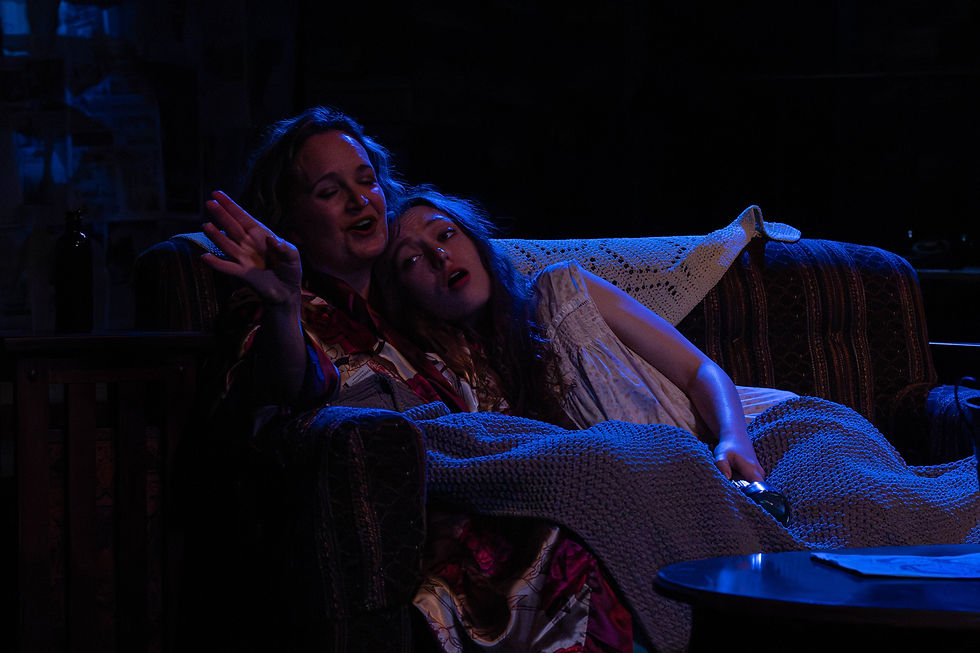
The action of the play revolves around Beatrice (Elizabeth Keith), her two daughters Ruth (Irene Denniston) and Tillie (Daphne Wheeler), and in an important non-speaking role, their elderly boarder, Nanny (Jeanne Adams). Beatrice is a role of a lifetime: both a considerable challenge for an actor and an opportunity to incandesce at the center of the story. Keith grounds her Beatrice in an appealing plausibility that frequently feels at odds with her lines. Her interpretation presents a woman who seems hurt and flawed, but is still holding it together as a member of regular society. Some moments work well with that approach, like her retelling of a familiar story about her childhood in the dark to Ruth. It also potentially gave her somewhere to go later on. Unfortunately, the explosion never really arrives: instead, the awful revelation of the plot relies mostly on the script itself (and the sharper performances of Denniston and Wheeler) to give the events weight. It’s possible that director Caro Dubberly was concerned about making her sympathetic: searching for humanity in her rather than making her a cartoon villain.
Wheeler’s Tillie is appealingly vulnerable and optimistic, and Wheeler, who must spend much of her time on stage listening and reacting, is precise and consistent in noticing and taking in the words of her mother and sister as she is ignored, berated, belittled, tolerated, and praised by turns. Specific gestures, like nervously grabbing the pleats of her skirt or turning her arms and face into her body as she takes in a fresh hurt, present an achingly plausible child who only knows how to process things inwardly. Her resilient joy in her scientific research represents the core hope of the play, and Wheeler’s longing and hopeful expressions in the midst of the turmoil of her home were poignant and effective.
Denniston’s Ruth, on the other hand, is half-way between her mother and her sister: smoking cigarettes and sharing lipstick with Beatrice while adoring the same rabbit that Tillie loves and that her mother keeps threatening to kill. Denniston displays some of the chaos energy that is too muted in Keith’s performance, and her precision with both timing and changing moods makes her the most powerful force on stage. Her eruption into the home while recounting the news about Tillie’s making the science fair finals is particularly joyful and affecting. “She beat out practically everybody and nobody laughed at her. ‘She’s my sister,’ I said. ‘She’s my sister!’”
The costumes, by Stephenie Yee, have the same problem that the set does: they’re beautiful and period-specific, but look too nice. Tillie is, according to the play, publicly humiliated at school. Ruth says: “My heavens, she was a sight. She had that old jumper on—the faded one with the low collar—and a raggy slip that showed all over and her hair looked like she was struck by lightning.” The Tillie in the production was in no danger of such mockery: her clothes and hair looked beautiful.
The production makes a strange choice regarding Nanny (Jeanne Adams), the elderly woman whose daughter is paying to be boarded in a spare room in the family’s home. So infirm that she seems oblivious to everything around her, she is subjected to ridicule and cruelty by Beatrice. Her first appearance is an absorbing feat of physical acting: I couldn’t take my eyes off of her as she crept on stage with her walker, then slowly established herself at the table, fingers shaking as she dealt herself a game of solitaire. In her second appearance, she emerges to find herself alone in the house and suddenly shakes off her seeming infirmity and moves with alacrity to get herself a beer. She got a huge reaction from the audience—it was the first big laugh of the evening—but it went unexplained afterward. Only after the play did I verify that it was not present in the script. As an idea, it plays. Big choices can be opportunities for productions to make a play their own.
But it underscores the risk of adding extra-textual dimensions: if the additional information they convey sits in tension with the script, the audience might well notice. In this case, the choice raises questions: why would Nanny feign her infirmity? Why does it help her to pretend to have trouble walking or to have shaking hands while she plays cards by herself? Is it some way of defending herself against Beatrice’s dismissive cruelty? Was it a way of trying to get extra attention from her daughter? For me, none of these possibilities seem satisfying. Instead, it felt like a funny moment that was added at the expense of the whole, a tell that the director felt uncomfortable with the darkness of the play itself and was looking for moments of relative lightness.
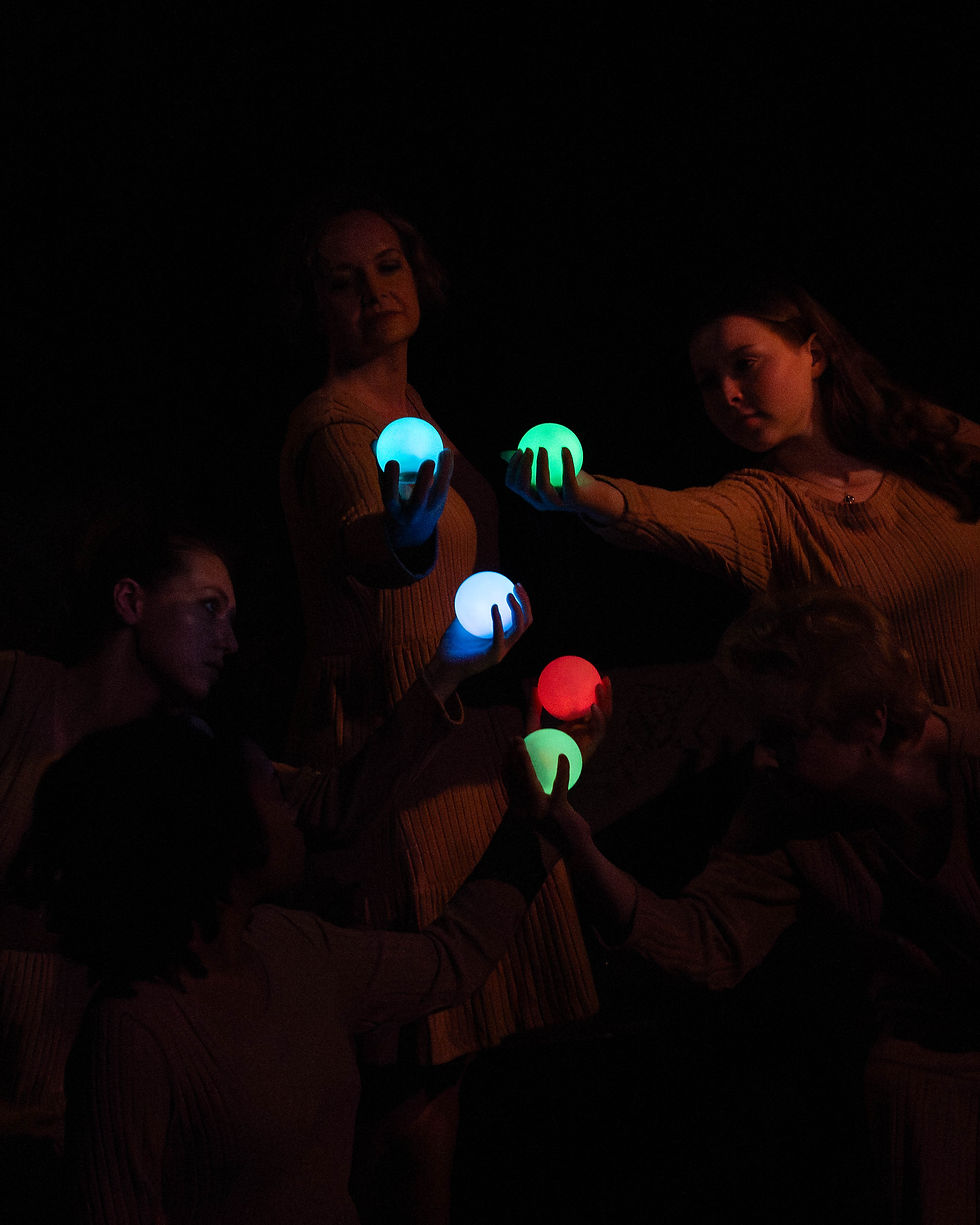
I would contrast it to a moment near the end of the play when this production inserts a kind of simulation of an atomic bomb, with a siren and non-verbal engagement from every member of the cast. It, too, was an extra-textual choice, but for me it was one of the most affecting moments of the show: it brought shivers down my arms. It felt like a way of expressing, in an abstract but sensorily intense way, the weight of potential annihilation that both the characters in the play and we ourselves inherit both in our personal lives through the legacies of our families and societally, with the the very real risk of nuclear war overshadowing our species.
The Blackbox Grit
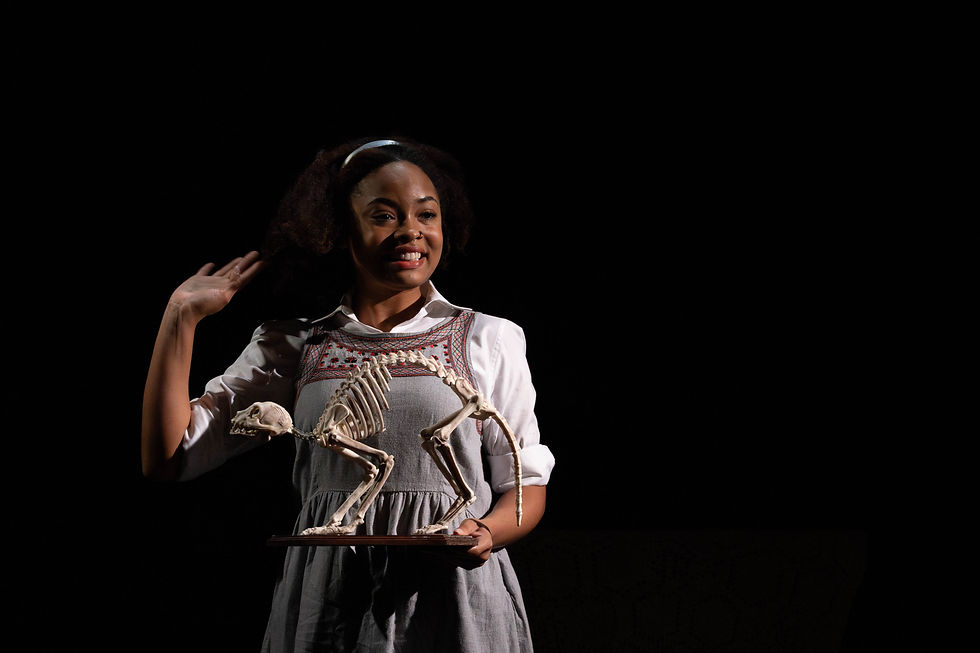
Asha-Ashanti Turner has a small but appealing turn delivering a monologue as a rival finalist in the science fair, playing a girl whose experiment involved skeletonizing a dead cat and displaying its bones. The grisly details of that act are an important part of the play, and the ghoulishness of her chipper, laugh-ready delivery might have been aided by more attention to prop acting: the plastic skeleton they used ought, in the world of the play, to be both heavy and delicate, qualities neglected in Turner’s performance.
As immersive as the physical world of the play was, a few other prop moments (like the lack of a real Stella Artois bottle that audibly pops when its cap is removed and the lack of prop cigarettes that emit anything resembling smoke) weakened its gravity in places. The use of real honey for Nanny’s hot water, however, was noticed and appreciated.
The moment later in the play where Beatrice pushes Ruth felt choreographed and weak. Safety is a fundamental requirement of anything that takes place on stage, but once that has been assured, impact is the second highest priority. Instead of providing an essential point of combustion of emotional potential into the world of the direct and the physical, it felt listless.
The house’s newspaper-covered windows—a sign both of poverty and of a disregard for even keeping up appearances—had two taped-on sections that get ripped away at a certain point, but look far too neat. I don’t mean to be insensitive to the difficulty involved in set and prop work, but it’s a moment where the practical concerns of a crew interested in a repeatable play might have overridden an opportunity for authenticity: really ripping apart those windows could have done a lot to help build Beatrice’s emotional escalation.
The Verdict
This was my first introduction to The Effects of Gamma Rays on Man-in-the-Moon Marigolds, and it made me a fan: Tillie’s hopefulness in the possibility of mutation and genesis in reaction to forces that seem fundamentally destructive is a theme that is surely as relevant now as it was in the play’s heyday of the ‘60s and ‘70s. But the play is deliberately horrific—I’d put it next to something like Veronica’s Room on my shelf. Downplaying the horror diminishes the purpose and triumph of the possible redemption in Tillie’s insight into the cosmic nature of human existence.
The Details
The Effects of Gamma Rays on Man-in-the-Moon Marigolds is a production by Silver Spring Stage, and runs through May 24th, 2026 at its black box theatre at 10145 Colesville Rd, Silver Spring, MD 20901. Written by Paul Zindel. Directed by Cora Dubberly. Running time is 90 minutes, with an intermission. Visit Silver Spring Stage’s website for information and tickets.

Comments