
When Sophistication Crumbles: Dark Horse Delivers a Visceral God of Carnage
- The Beltway Blackbox
- Dec 3, 2025
- 4 min read

Updated: Mar 10
E. Hayes: Critic, The Beltway Blackbox
In the theater, the most terrifying battles often occur not in the epic landscapes of war, but across a coffee table. Dark Horse Theatre Company, under the sharp direction of Natasha Parnian, stages Yasmina Reza’s God of Carnage as a definitive 90-minute autopsy of civility, proving that the modern parental unit is merely a thin veneer laid over primordial rage. This is less a play and more a rapid-fire cultural indictment, leaving the audience to choke on the sticky remains of apple-pear cobbler and the residue of shattered domestic tranquility.
The production’s power is established before a single line is spoken. The Novak’s living room, with its off-beat, African-inspired design, immediately feels like a space brimming with warmth and personality. Clever layout and thoughtful details create a feeling of immersion, making you feel instantly present within the room. The decor functions less as a backdrop and more as a vibrant, lived-in sanctuary reflecting the richness the characters strive to maintain.

This sense of complicity is deepened by the pre-show choices: Dark Horse meticulously designed the pre-show elements to bridge the gap between audience and narrative, giving patrons the literal stick as their ticket and a “Reza Elementary School PTA” election brochure as their program. These details cleverly implicate the viewer, framing the ensuing conflict not as drama, but as inevitable social warfare.
Parnian’s brilliance lies in her refusal to let the chaos become noise. While the script inherently risks dissolving into a flat, monotonous shouting match, this cast and director smartly avoid this trap by finding the precise emotional calibration in every insult and outburst. The precise blocking, utilizing chess match like staging to signal dominance and retreat, ensures the emotional stakes are constantly shifting.

The four performers create a mesmerizing and terrifying quartet. The hosts begin their evening with a overly considerate communication that gradually collapses.
Samantha Mitchell’s portrayal of Veronica brings a deep vulnerability. As the self-appointed moral guardian, she reveals superiority not as arrogance but as a brittle, cracking shield against reality. Her mounting frustration with her marriage feels painfully earned rather than theatrical. Mitchell masterfully uses stillness and pauses, then sudden (sometimes unpredictable) reactions to chart Veronica’s internal landscape. When confronting the others, her voice remains tightly restrained, but the subtle clench of her jaw or the way she avoids eye contact reveals the character’s profound fear of losing control. The moment she ultimately loses composure, will break your heart. This constant struggle between the rigid front and the breaking spirit makes her performance intensely compelling.
Tim Byer’s Michael embarks on a devastating arc. He begins as the accommodating, good-natured husband; over time we see the slow, profound deterioration of his attraction to his wife and the desire for the life he knows. Speaking of desire, his attempted infidelity is absolutely cringe-worthy. His unraveling is tragic, pathetic, and deeply chilling. His transformation “into a Neanderthal” marks the domestic demise of the life he and his wife once knew. Byer’s performance is a clinic in physical acting. His shoulders sag imperceptibly as the night wears on, and the hesitant, almost apologetic quality of his laughter when he refers to his fond memories of being a gang leader morphs into a hollow, defeated sound when he is crushed by his wife. The way he holds his coffee cup, or the vacant stare he uses when he retreats into his own head are really telling of his internal condition.
The Raleighs are a study in modern connection; they were very clearly in love, but struggled deeply with modern technology obstructing their communication. The crisis forces their distance into the open and shows how easily tolerance can snap into contempt.
Alan Raleigh is portrayed by Nate Eagle as a coiled spring of indifference; his intensity and brutal honesty build a character who treats the crisis not as a serious dilemma but as an irritating interruption to the primary relationship in his life: his cell phone. Eagle’s performance is driven by meticulous control. You get the sense that everything his character does is calculated. He starts the evening as a polished, socially comfortable lawyer: dismissive, measured, and emotionally distant. His composure never collapses with dramatic outbursts; instead, it erodes gradually through clipped speech, restless pacing, and small, impatient gestures like adjusting parts of his suit or checking his Blackberry phone. By the end, Eagle allows a sudden vulnerability to surface; the quiet, shared gaze he offers his wife is a heartbreaking moment of reconnection, suggesting that their partnership, though battered, has an enduring core. His quiet moment, of putting on his wife’s shoes for her, becomes a powerful final statement of commitment.

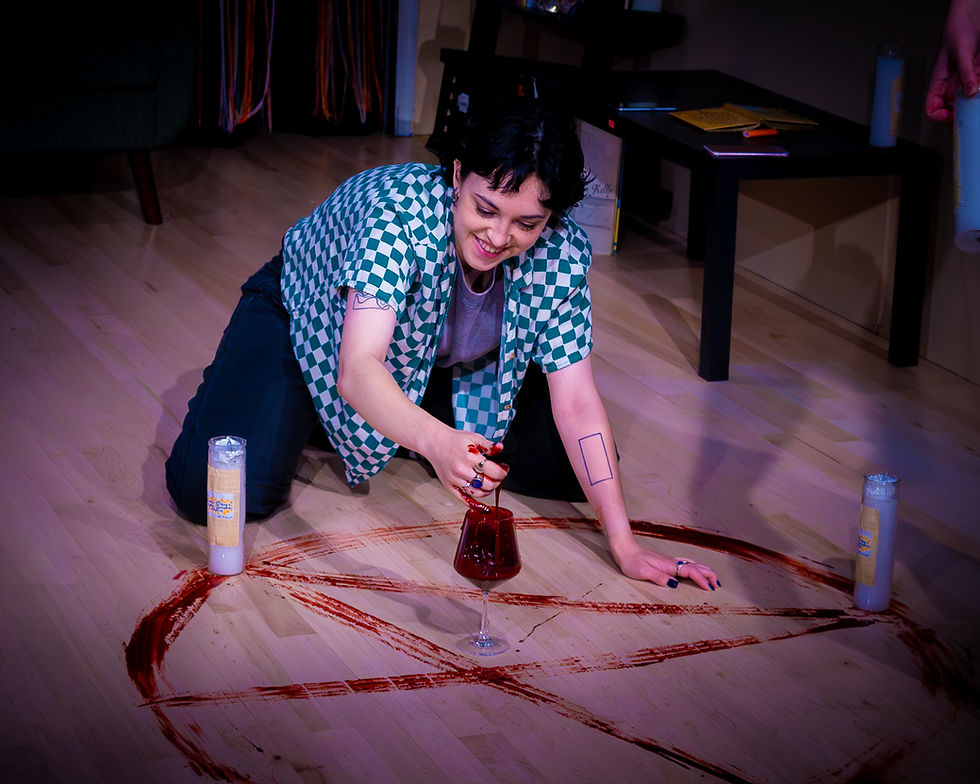
Annette Raleigh, played by Arianne Warner, delivers a masterclass in control with tamped down deep marital and motherhood fatigue just below the surface. Her performance is both fragile and explosive. Warner’s trajectory is the most visceral, using her whole self to illustrate the pressure building up beneath the surface. Rather than simply showing frustration, Warner crafts Annette’s slow-burn collapse through precision in details: her unwavering eye contact becomes a mechanism of her control, the cat-like seduction of the men in the room is never heavy-handed, and the vocal shift from a clear register to a tight, strangled breath when her son is called “an executioner” charts the character’s internal pressure cooker. Even though her character can be flawed and vapid (she gets tremendously upset about her broken makeup compact), her breakdown feels raw and heartbreaking, as resentment and fatigue give way to to her literal eruption. Be careful sitting in the front row.
Known for their dedication to actor-driven exploration and deep textual commitment, Dark Horse Theatre Company has succeeded by executing this text with precision and impact. They remind us that the beast of rage is never far beneath the skin of polite society. This production holds a mirror up to the audience that is hilarious, uncomfortable, and profoundly resonant.
Running time: 90 minutes (no intermission)
God of Carnage, from Dark Horse Theatre Company, ran November 14–29, 2025 at St. Francis Episcopal Church in Great Falls, VA — and returns December 5–7, 2025 at Arts Herndon in Herndon, VA. Showtimes: Fridays and Saturdays at 8:00 p.m., with a Sunday matinee on December 7 at 2:00 p.m. Tickets are $20 and available for purchase online at www.darkhorseva.com

Comments